
Writing Journey Part 3: Plot x2
Diving into craft books begins a deep dive into learning how to developmentally edit my manuscripts.

It took me more than five books to consider I needed to look more at plot. (See my previous posts about my writing journey here and here.) The class I took from my local writing group mentioned two plots, a new concept to me, and recommended two books. And when I asked which would be better to start with, the answer was Save the Cat.
Before I get into how helpful this book was to me and my writing journey, I need to share an aspect of my perspective. And to clue you in, I’m very comfortable learning and existing in a procedural way. But also, my brain loves loves loves to find and create connections. I’m the person that will play 6 degrees of separation with ✨ideas.✨
So, here’s my take on plot.
They’re all the same.
And perhaps, as I build up my blog, I’ll post on how individual plots match other individual plots (say, Romancing the Beat vs. the Hero’s Journey). No promises though! I let creativity take me where it will. For now I’ll start with the basics, which is, inherently, why they are all essentially One Plot.
One Plot to Rule them All
Every story has a beginning, a middle and an end. Which means every story has a three-act plot. (Yes, even four-act plots, but that’s also another post.)
It’s like the video of comedian Rob Paravonian when he sings his “Pachelbel’s Rant.”
Just like many pop songs of today have the same four chords of a song from the 1700s, many of our stories have the same structure.
And that, essentially, is where Save the Cat! comes from. From a screenwriter who noted that stories have similar elements. And these revolve around the beginning, the middle, and the end.
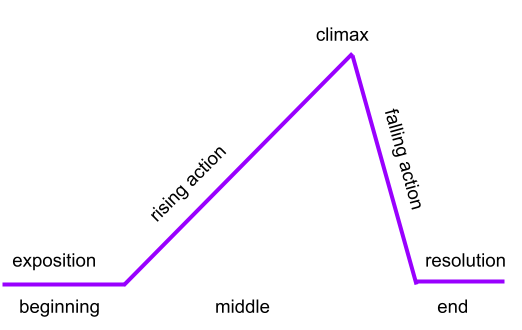
We can identify these parts. We’ve all seen the plot diagrams from school:
The Two Main Plot Points
All of these plot structures work, and all are inherently the same plot, because they all center on two focal points for the story. The inciting incident and the climax. The two places in the book where the main plot shoves the character into a journey and where the character resolves this main plot. What comes before the main plot is introduced is the exposition in the beginning. What comes after is the falling action and resolution toward the end, and everything in the middle is how the character keeps interacting with smaller pieces of this main plot to find a way to resolve it.
Don’t get me wrong, a story can exist in any form, and a story that has a beginning, middle, and end accomplishes much. And my writing definitely had beginnings, middles, and ends up to this point. But I still felt that something was missing. They weren’t polished. And at this point in my writing journey, I didn’t know what they needed to be polished. And it was that frustration that led me to dive deeper and learn more about the craft of writing. It was also that frustration that had me hold back the desire to send my book out to agents and query it. I knew it wasn’t ready yet, and I didn’t want to send out anything but my best work. So, I took the time to find out what my best work might look like when meshed with the kind of story agents and editors are looking to publish.
I dove into a new part of my writing journey: learning about craft. And the first book I turned to was Save the Cat! Writes a Young Adult Novel.
Save the Cat! Writes a Young Adult Novel
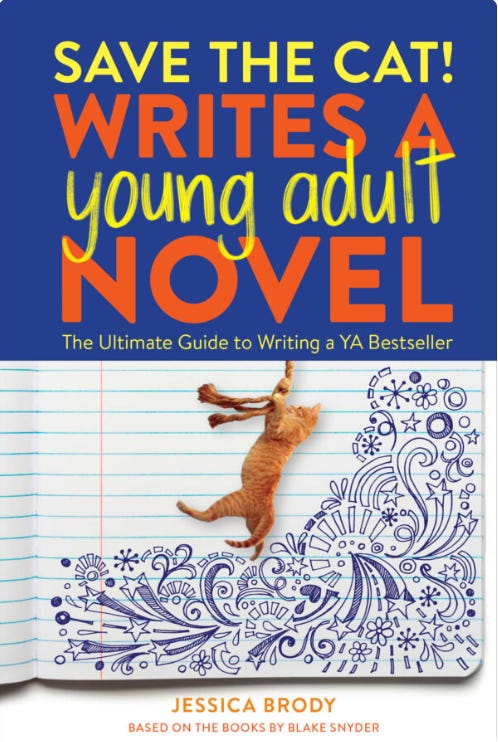
The meat of this book is organized by describing where to start with your hero, describing the individual plot beats, and then by offering full novel beat sheets in each of the ten genres (differently defined than conventional genres). There are thirteen beats a story should hit along its course, and Brody goes in depth into what should happen in each one with examples from various YA novels. What I loved most about this book and what really worked for me were the examples. I struggle to see how to put technique into action without a plethora of examples to draw from and Save the Cat delivers.
How Save the Cat! Helped my Writing
I found this book to be what I needed to take the next step in my writing journey. The first chapter goes into the main character (or hero). This book is a soft intro to the internal plot arc of the main character. The main character needs to come with a problem, a want, and a need. And my favorite quote from the book explains how the internal plot and external plots are linked:
“Storytelling is essentially just a series of choreographed steps: external events, which trigger internal realizations, which inspire proactive decisions. With each external event and internal realization it triggers, we get closer to the ultimate internal realization and the ultimate transformation” (Brody, 49).
This quote was the first key to me unlocking a better novel. Taking the baggage the character has at the beginning of the story, the external plot is a force that drives them toward the change they need to undergo to be a more whole and complete person. And the beats where this character most encounters this change is the debate, somewhere just after the midpoint, the dark night of the soul, and the dig deep down. These are the main points where a character needs to have their inner thoughts and desires clearly expressed on the page. And yes, judging from some initial feedback on my early writing, this was something I needed to add to my story.
Save the Cat took the plot diagram I’d learned in school, and added a whole bunch of meat to it. I decided to shelve my fantasy trilogy. It had more plot problems than I was ready to dissect, especially being a multi-POV work. Instead, I turned to one of my most recent manuscripts: a middle grade novel with a single POV. A story I drafted in 11 days and completed at 38,000 words. I used the beat sheet to re-plot this story, focusing on the problem, the want, and the need of my 12-year-old character. I set up my Scrivener file in the manner of the beats, giving myself extra text files for the multi-scene beats. I rewrote my story from beginning to end. The result? I had the most coherent plot I’d created yet. But I wasn’t ready to query this story. Not yet. It still needed something more.
Brody, Jessica, Save the Cat! Writes a Young Adult Novel. New York, Ten Speed Press. July, 18, 2023.
Hey, great read as always, your articulation of the singluar plot paradigm is so insightful, yet I find those distinct plot algorithms offer unique structural heuristics.